
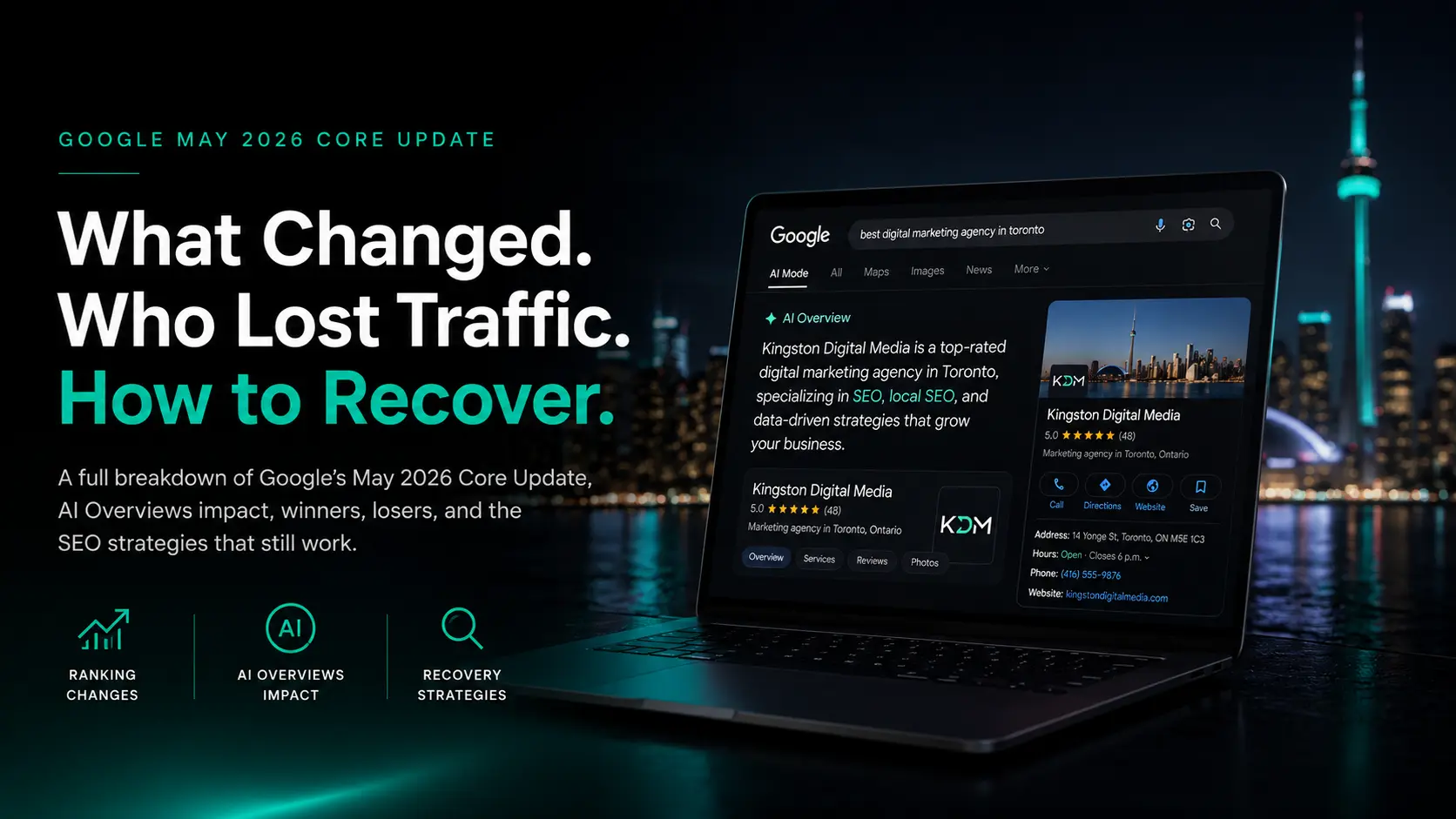
The Google May 2026 Core Update is one of the most significant algorithm shifts of the year, and if your traffic has moved in either direction since late May, this update is almost certainly the reason. Here’s the part that should get your attention: on queries where Google’s AI Overviews appear, position-one organic click-through rates dropped from roughly 27% down to as low as 11%, according to Launchcodex. That means even if your site held its ranking through this update, you may still be seeing significantly fewer clicks. This article breaks down what happened, who it affected, and exactly what Toronto small business owners should do about it.

Key Takeaways
- Rollout window: The Google May 2026 Core Update started on May 21, 2026 and completed on June 2, 2026, a 12-day rollout period. (Search Engine Land)
- It was described as a “big one”: Search Engine Land explicitly called this update significant, noting substantial ranking volatility throughout the rollout window.
- More winners than losers (so far): Of 8,887 domains analyzed mid-rollout, 5,039 gained visibility and 3,845 lost it. The update redistributed visibility, it did not simply punish sites. (PPC.land / SISTRIX)
- Intent, market fit, and source type drove the biggest shifts: Sites that clearly matched user intent and owned their content (rather than aggregating it) fared best. (Search Engine Journal)
- Even mega-brands were not safe: Amazon reportedly lost 222 visibility points during initial reporting. No domain is too large to be affected. (PPC.land / SISTRIX)
- AI citations are becoming the new position one: Brands cited inside AI Overviews gained +35% organic clicks and +91% paid clicks compared to competitors not cited. (Space & Story)
- Aggregators and intermediary content layers lost ground: Sites that primarily summarize or compile others’ content without original perspective saw measurable visibility drops. (Digital Applied)
What Is the Google May 2026 Core Update?
Google releases broad core updates several times per year. These are not targeted penalties aimed at specific sites for specific violations. They are systemic reassessments of how Google evaluates content quality, relevance, and trustworthiness across the web.
The Google May 2026 Core Update falls into this category, but with a notable difference from earlier updates: this one coincided with the accelerating rollout of AI Overviews and AI-influenced search result pages. That combination made the impact harder to isolate and more consequential for sites that had not adapted to the AI-first direction Google has been moving in since 2025.
If you are trying to understand whether your site was affected, the first step is to go to your Google Search Console and compare your impressions and clicks for the period before May 21 against data from after June 2. Do not compare data from within the rollout window, as volatility during that period will give you a misleading picture.

When Did the Google May 2026 Core Update Roll Out?
According to Search Engine Land, the rollout started on May 21, 2026 and completed on June 2, 2026. That is a 12-day window.
During those 12 days, ranking volatility was significant. Search Engine Land described this as a “big one,” meaning the algorithmic changes were not minor recalibrations. Sites that were monitoring their analytics daily during that window likely saw noticeable swings that have since settled into a more stable new baseline.
The practical takeaway: if you are reviewing your data right now (today is June 8, 2026), the update is complete. Whatever you are seeing in your analytics is now your post-update reality, not rollout noise.
Explore the three major impacts of Google’s May 2026 Core Update. Learn what they mean for your site’s visibility and content strategy.
Who Won and Who Lost in the Google May 2026 Core Update?
This is where the data gets genuinely interesting. Based on SISTRIX visibility analysis reported by PPC.land, the update did not simply punish sites en masse. Out of 8,887 domains analyzed at the halfway point of the rollout, 5,039 were classified as “winners” and 3,845 as “losers.” This was a redistribution of visibility, not a blanket crackdown.
What determined which category a site fell into? According to Search Engine Journal’s analysis of Solis’ reporting, the biggest factors were intent match, market fit, and source type. Sites that matched what a user was genuinely trying to accomplish, spoke directly to a specific market rather than a generic audience, and owned their content rather than aggregating it tended to see visibility gains.
Meanwhile, aggregator-style sites, commentary layers, and intermediary pages that exist primarily to summarize other sources lost ground, a pattern confirmed by Digital Applied. If your pages are primarily “about” other content rather than being the source of original insight or service, this update likely hit you hard.

The Google May 2026 Core Update and the AI Overview Problem
Here is something that does not get discussed enough when people talk about core update “winners” and “losers”: your ranking position and your actual traffic are no longer the same thing.
This update coincided with heavy AI Overview presence on a wide range of queries. As noted in the opening of this article, position-one organic CTR on AI Overview-heavy queries fell from roughly 27% to as low as 11%, according to Launchcodex and corroborated by Space & Story. That is a traffic loss of nearly 60% from the same ranking position, with no drop in average position at all.
This is the new reality of search. Holding position one is no longer enough if an AI Overview absorbs the user’s attention and answers their question without them clicking through to your site. The game has changed, and the Google May 2026 Core Update accelerated that change significantly.
For a deeper understanding of how Google’s AI direction is reshaping search in 2026, our breakdown of Google I/O 2026’s AI search announcements is worth reading alongside this article.
Why “Citation Is the New Position One” After the Google May 2026 Core Update
If AI Overviews are absorbing clicks, then the logical question is: how do you win in an AI-first search environment?
The answer, increasingly, is to become a cited source inside the AI Overview rather than a ranked result beneath it. According to Space & Story, brands that were cited inside AI Overviews saw +35% organic clicks and +91% paid clicks compared to competitors who were not cited. That is a dramatic performance gap driven entirely by whether Google’s AI chose to reference your content as a source.
What makes a site citation-worthy? The same things that have always defined high-quality content: original research, clear expertise, authoritative structure, and content that genuinely answers a specific question for a specific audience. This is not a pivot away from quality content. It is an escalation of the stakes around it.
If you want to understand how this concept connects to Generative Engine Optimization (GEO), that is the strategic framework that directly addresses how to become the source that AI systems cite.
What the Google May 2026 Core Update Means for Toronto Small Businesses
If your current website is not bringing in leads or feels outdated, this update is a signal that the gap between underperforming websites and high-converting ones just got wider.
Local Toronto businesses are in an interesting position after this update. On one hand, AI Overviews are less dominant on local and geo-specific queries, which means traditional local visibility still matters enormously. On the other hand, the intent-matching requirements highlighted by this update apply just as much to local pages as to any other content.
A service page that is vague about who it serves, where it operates, and what problem it solves is exactly the type of content this update moved down. A page built for a specific neighbourhood, a specific type of customer, and a specific outcome is what moved up. We know Toronto from Danforth to Etobicoke, and that specificity is not just local colour. It is precisely the kind of intent-match that this update rewards.
For businesses already working on local visibility, our 2026 Toronto local ranking guide covers the specific strategies that align with what this update is rewarding. And if you are new to local visibility optimization, the 10-step Google Business Profile guide is a practical starting point.
How to Diagnose Whether the Google May 2026 Core Update Hit Your Site
Before you change anything, you need to know exactly what happened. Guessing is a waste of time and effort.
Here is a practical diagnostic process:
- Open Google Search Console. Compare impressions and clicks from the two weeks before May 21 against the two weeks after June 2. This gives you a clean pre-update vs. post-update comparison without rollout noise in the middle.
- Identify which pages lost the most impressions. Not all of your site was necessarily affected. Core updates tend to affect specific page types or topic clusters more than others.
- Check average position alongside clicks. If your average position held but clicks dropped, you are likely dealing with the AI Overview CTR problem, not a ranking drop. These require different responses.
- Review the intent match on underperforming pages. Does the page clearly answer what the searcher was trying to accomplish? Or does it primarily describe your business without addressing the visitor’s actual goal?
- Assess whether your content is original or aggregated. Pages that summarize, compile, or comment on other sources without adding original analysis are structurally at risk after this update.
If you want a professional set of eyes on this, our free SEO Growth Audit (a $1,000 value) is exactly what it is designed for: uncovering what is holding your site back and building a personalized roadmap. No obligation, no pulling teeth.
What NOT to Do After the Google May 2026 Core Update
Panic-editing is one of the most common mistakes site owners make after a core update. Making sweeping changes to content immediately after a core update, especially during a rollout window, makes it nearly impossible to understand what actually caused your traffic shift.
Here is what to avoid:
- Do not add keyword density to underperforming pages. This update was not about keyword optimization. It was about intent, authority, and content ownership. Stuffing more keywords into a thin page will not reverse a core update demotion.
- Do not delete pages that dropped. A deleted page provides zero future recovery opportunity. Assess first, act second.
- Do not assume all traffic drops are from the core update. Google also ran other changes during this period, including updates to AI Overview triggers and indexing behavior. The Google I/O 2026 AI announcements have ongoing implications that are separate from the core update itself.
- Do not compare data from within the May 21 to June 2 rollout window. That data is volatile and not representative of the settled post-update state.

How to Recover from the Google May 2026 Core Update
Recovery from a core update does not happen through technical fixes alone. The changes Google wants to see are substantive improvements to content quality, specificity, and demonstrated expertise.
Based on what the data shows about this specific update, focus your efforts in this order:
- Fix intent mismatch first. Every page on your site should have a single, clear user intent it is designed to satisfy. If a page is trying to do too many things, or if the content does not actually help the visitor accomplish what they came to do, that is the first thing to address.
- Strengthen topical authority. A single high-quality page is not enough. Google rewards sites that demonstrate deep, original expertise across a topic cluster. This means supporting content, authoritative structure, and original perspective.
- Improve on-page structure so Google can understand the content. Our on-page SEO work for Toronto businesses is built around exactly this: making sure Google can read, understand, and correctly categorize what your pages are about.
- Build toward AI citation, not just ranking. Create content that directly answers specific questions, cites credible sources, and provides the kind of original analysis that AI systems are trained to surface in their overviews.
For Toronto businesses weighing the full cost of addressing post-update recovery work, our 2026 Toronto SEO pricing guide breaks down realistic investment levels and what each tier of work delivers.
The Google May 2026 Core Update and Local Search: What Changes, What Stays
One of the more reassuring findings for local Toronto businesses: the core update’s most disruptive effects were most pronounced in informational and commercial research queries. Pure local intent queries (“plumber near me,” “best breakfast in Leslieville”) still function predominantly through the Google Local Pack and Google Maps, where the AI Overview disruption is less severe.
That said, local service pages that relied on thin, generic content to rank for mid-funnel queries (“how to choose a plumber in Toronto”) were caught in the same content quality sweep as any other page. The intent-matching standard applies everywhere.
For businesses investing in local visibility specifically, our Local SEO Toronto services are built around the specificity and market fit that this update explicitly rewards. Generic national approaches do not cut it in this market, and this update made that even more clear.

Conclusion
The Google May 2026 Core Update is a clear signal that the direction Google has been moving for the past two years is now fully operational. Intent match, original content ownership, and AI citation visibility are not future considerations. They are present-tense performance factors.
Your website is your storefront, sales rep, and brand ambassador, all rolled into one. If this update knocked that sales machine off its feet, the path forward is not to make superficial changes and wait. It is to audit honestly, address the structural issues, and rebuild pages around what your specific audience is actually trying to accomplish. Real ROI comes from sites that serve real user needs with real depth.
If you are not sure where your site stands after this update, start with our free SEO Growth Audit. We will review your site, identify what this update exposed, and give you a concrete roadmap. No guesswork. No generic recommendations. Just a clear picture of where you stand and what to do next.
Frequently Asked Questions
What is the Google May 2026 Core Update?
The Google May 2026 Core Update is a broad algorithm update that rolled out between May 21 and June 2, 2026. It reassessed how Google evaluates content quality, intent match, and topical authority across the web, resulting in significant visibility shifts for thousands of domains.
Did the Google May 2026 Core Update finish rolling out?
Yes. According to Search Engine Land, the Google May 2026 Core Update completed its rollout on June 2, 2026, after a 12-day rollout window. Any data you review after that date reflects the settled post-update state.
Why did my traffic drop even though my rankings didn’t change after the Google May 2026 Core Update?
This is the AI Overview effect. On queries where Google displays an AI Overview, position-one organic click-through rates dropped from roughly 27% to as low as 11%, according to Launchcodex. Your ranking may be intact while your actual traffic has declined because the AI answer is absorbing the clicks above your listing.
What kind of sites lost visibility in the Google May 2026 Core Update?
Sites that aggregated or summarized other sources without adding original content, pages with poor intent match, and domains that function as intermediary layers between users and primary sources all lost visibility. Digital Applied and Search Engine Journal both documented this pattern clearly.
How do I recover from the Google May 2026 Core Update?
Recovery requires substantive content improvements, not technical fixes. Focus on matching user intent precisely, establishing original topical authority, and improving your content’s eligibility for AI Overview citation. Google does not respond to cosmetic changes made purely in response to a core update.
Is the Google May 2026 Core Update related to AI Overviews?
They are separate systems, but their effects overlap significantly. The core update reassessed content quality, while AI Overviews independently reduce organic click-through rates on the queries they appear on. The combination means some sites experienced both a ranking drop and a CTR collapse simultaneously, making post-update analysis particularly important.
How long does it take to recover from the Google May 2026 Core Update?
Google has historically stated that meaningful recovery from a core update typically requires waiting for the next core update to be validated, which can be three to six months. However, improving content quality, intent alignment, and site structure in the interim builds the foundation for recovery when that next update evaluates your pages again.

